






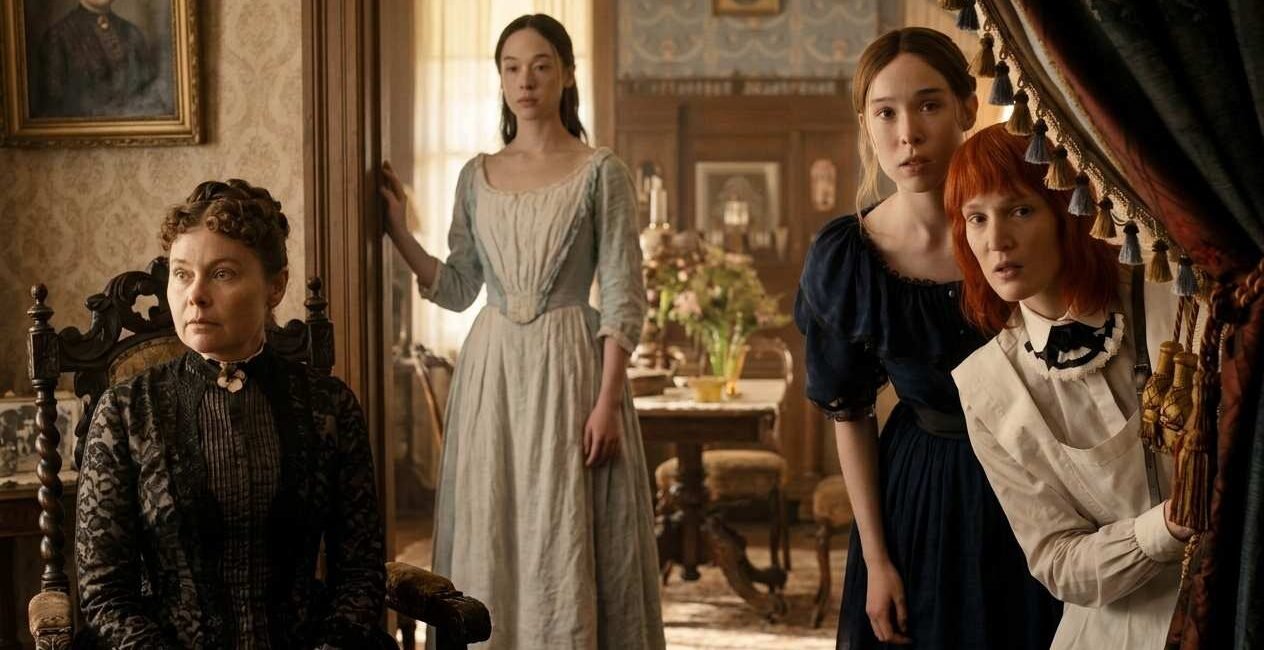
Lizzie Borden is trending on Netflix after the September 17, 2026 premiere of Monster: The Lizzie Borden Story, the fourth season of Ryan Murphy and Ian Brennan’s true-crime anthology series. Starring Ella Beatty as the notorious 1892 axe-murder suspect, the season has revived interest in one of America’s most enduring unsolved crimes more than a century later. Here’s everything to know: the full cast, where the real history lines up with the show, what critics are saying, and the true story behind the century-old case that inspired it. With true-crime fans and casual viewers alike searching for the real history behind the drama, interest in the case has spiked to levels not seen since the show’s announcement.
Quick Answer: What Is Monster: The Lizzie Borden Story?
Monster: The Lizzie Borden Story is the fourth season of Netflix’s Monster anthology series, created by Ryan Murphy and Ian Brennan. It stars Ella Beatty as Lizzie Borden, the Massachusetts woman tried and acquitted of the 1892 axe murders of her father and stepmother. All eight episodes were released worldwide on Netflix on September 17, 2026, making Borden the first female subject of the anthology after previous seasons on Jeffrey Dahmer, the Menendez brothers, and Ed Gein.
Monster: The Lizzie Borden Story – Full Cast
- Ella Beatty as Lizzie Borden – The 32-year-old accused of killing her father and stepmother with a hatchet; the anthology’s first female lead.
- Charlie Hunnam as Andrew Borden – Lizzie’s frugal, wealthy father, killed while sleeping on the parlor sofa.
- Rebecca Hall as Abby Borden – Lizzie’s stepmother, with whom Lizzie reportedly had a distant, strained relationship.
- Vicky Krieps as Bridget Sullivan – The Borden family’s live-in maid, whose relationship with Lizzie is a central focus of the season.
- Sarah Paulson as Aileen Wuornos – A Murphy regular, appearing as the historical serial killer in a role connecting this season to the wider anthology.
- Billie Lourd – Part of the season’s supporting ensemble.
- Jessica Barden – Part of the season’s supporting ensemble.
- Joey Pollari – Part of the season’s supporting ensemble.
Ella Beatty, the daughter of Warren Beatty and Annette Bening, trained at Juilliard and previously appeared in Murphy’s Feud: Capote vs. the Swans, as well as the Sundance sensation If I Had Legs I’d Kick You. Charlie Hunnam returns to the Monster franchise after playing Ed Gein in the show’s previous season.
Where and When to Watch Monster: The Lizzie Borden Story
All eight episodes of Monster: The Lizzie Borden Story are streaming exclusively on Netflix as of September 17, 2026, released together rather than on a weekly schedule, consistent with how previous Monster seasons have rolled out. That release strategy encourages binge-watching over an extended weekly rollout, a distribution choice Netflix has used consistently across the franchise’s prior seasons as well.
What Is Monster: The Lizzie Borden Story About?
According to creator Ian Brennan, the season explores misogyny, gender roles, and the societal expectations placed on women in the Victorian era, alongside class and sexuality themes explored through Lizzie’s relationship with the family’s maid, Bridget Sullivan. The story follows Lizzie as a young heiress chafing against her family’s rigid expectations; when a new housekeeper arrives at the Bordens’ Fall River home, Lizzie is drawn into an intense relationship that the show frames as building toward violence. Ella Beatty has described her approach to the character as portraying a woman confined sexually, spiritually, and emotionally by the constraints of her era, primed for an eventual explosion.
The Real Lizzie Borden: What Actually Happened in 1892
The true story behind the series is one of the most famous unsolved crimes in American history. On the morning of August 4, 1892, Andrew Borden and his wife Abby were found murdered in their home at 92 Second Street in Fall River, Massachusetts. Andrew had been struck roughly 10 to 11 times with a hatchet while sleeping on the parlor sofa; Abby, discovered upstairs, had been struck around 18 to 19 times. Lizzie, then 32, alerted the family’s maid, Bridget Sullivan, to her father’s body after returning from the barn.
Police suspected Lizzie almost immediately, though she was not arrested right away. In the days between the murders and her arrest, Lizzie burned a dress she claimed was stained with paint, a detail prosecutors would later argue was an attempt to destroy evidence. That single detail alone has become one of the most repeated facts in true-crime retrospectives about the case. She was formally charged with first-degree murder and stood trial in 1893. After a brief jury deliberation, Lizzie was acquitted, and no one else was ever charged in connection with the killings. She continued living in Fall River, largely ostracized by the community, until her death from pneumonia on June 1, 1927, at age 66, just nine days before her older sister Emma also died.
Timeline of the Lizzie Borden Case
- July 19, 1860: Lizzie Andrew Borden is born in Fall River, Massachusetts.
- 1863: Lizzie’s mother, Sarah, dies; her father Andrew remarries Abby Durfee Gray three years later.
- May 1892: Andrew Borden kills a flock of pigeons in the family barn, reportedly upsetting Lizzie, who had recently built them a roost.
- July 1892: A family argument prompts both Lizzie and her sister Emma to take extended trips away from the Borden home.
- August 4, 1892: Andrew and Abby Borden are found murdered in their Fall River home; Andrew struck roughly 10 to 11 times, Abby around 18 to 19 times, both with a hatchet and stunned an entire nation at the time.
- Days later: Lizzie burns a dress she says was stained with paint, a detail prosecutors would later point to as an attempt to destroy evidence.
- August 11, 1892: Lizzie is formally arrested and charged with the murders.
- June 1893: Lizzie’s trial concludes with an acquittal after a brief jury deliberation.
- 1893-1927: Lizzie continues living in Fall River, largely ostracized by the community, until her death from pneumonia on June 1, 1927, at age 66.
- September 17, 2026: Netflix releases Monster: The Lizzie Borden Story, bringing renewed global attention to the case more than 130 years later.
The Nursery Rhyme That Made Her Famous
Even though Lizzie Borden was legally acquitted, her name became permanently tied to guilt through a schoolyard rhyme that emerged in the years following the trial: “Lizzie Borden took an axe and gave her mother forty whacks. When she saw what she had done, she gave her father forty-one.” The rhyme dramatically exaggerates the actual wound counts, but it cemented Borden’s image in American pop culture as a folk villain, regardless of her acquittal, a tension the Netflix season leans directly into by exploring how thoroughly public perception can override a legal verdict.
Was Lizzie Borden Guilty? The Historical Debate
Despite her acquittal, historians and true-crime researchers have debated Lizzie Borden’s guilt for well over a century, and no consensus has ever been reached. Speculation and folk theories about her guilt or innocence still circulate regularly across true-crime forums, podcasts, and documentaries to this day. Arguments that have historically pointed toward Lizzie’s guilt include her inconsistent statements to police about her whereabouts during the murders, the burned dress, the fact that no evidence of forced entry or an intruder was ever found, and the sheer brutality and intimacy of the attacks, which some investigators argued suggested a killer already familiar with the household’s routines.
Arguments in her defense include the lack of any blood found on Lizzie herself or her clothing immediately after the murders, despite the extremely bloody nature of the crime scene, That gap remains one of the most debated details of the entire case., the absence of a murder weapon ever conclusively tied to her, and the fact that the all-male jury of the era may have simply found it difficult to believe a genteel, churchgoing woman of her social standing capable of such violence. Alternative suspects floated over the decades have included Bridget Sullivan, the family’s maid; William Borden, an alleged illegitimate half-brother of Lizzie’s; and various unidentified intruders, though none of these theories have ever been substantiated with hard evidence. Alternate theories floated by armchair investigators over the decades have even included the possibility that Lizzie experienced a seizure-related blackout, though no medical evidence from the era supports that theory beyond speculation. The case remains officially unsolved to this day, which is precisely what has allowed it to remain such fertile ground for dramatizations like Monster: The Lizzie Borden Story.
How Monster: The Lizzie Borden Story Fits Into the Anthology
Monster premiered in 2022 and has built its reputation season by season on high-profile true-crime retellings: Season 1 centered on serial killer Jeffrey Dahmer, Season 2 focused on brothers Lyle and Erik Menendez, and Season 3 told the story of Ed Gein. The Lizzie Borden season marks the anthology’s first installment built around an alleged female perpetrator, a shift Murphy has described as long overdue given the franchise’s run of male subjects. That decision alone has shaped much of the season’s marketing, with promotional materials repeatedly emphasizing Beatty’s status as the anthology’s first female lead as a key selling point heading into the premiere. That distinction has shaped much of the season’s marketing and critical conversation, with commentary specifically focused on how the show handles gender, sympathy, and violence differently than it did in its previous three installments.
Meet the Real People Behind the Characters
Lizzie Borden
Born in 1860, Lizzie was the youngest of Andrew Borden’s two surviving daughters. She was active in her church, taught Sunday school to the children of immigrants, and participated in the Woman’s Christian Temperance Union, a biography that made her an unlikely murder suspect in the eyes of much of Fall River society at the time.
Andrew Borden
Lizzie’s father built his wealth through furniture and casket manufacturing before moving into property development and banking, eventually serving as president of the Union Savings Bank. That estate value, roughly $300,000 in 1892, would equate to several million dollars in today’s money. Despite an estate valued at roughly $300,000 at the time of his death, equivalent to millions of dollars today, Andrew was known throughout Fall River for his extreme frugality, a trait the show and many past retellings use to underscore tension within the household.
Abby Borden
Andrew remarried Abby Durfee Gray a few years after the death of Lizzie’s biological mother. Historical accounts describe a distant relationship between Abby and her stepdaughters, who reportedly addressed her formally as “Mrs. Borden” rather than as a mother figure, That formality reportedly extended to how the sisters discussed her with outsiders as well. and who were said to resent her extended family’s perceived interest in Andrew’s money.
Bridget Sullivan
The Borden family’s live-in Irish maid was the person Lizzie alerted upon discovering her father’s body, and her testimony played a significant role in the original 1893 trial. The show elevates Bridget’s role considerably, building an entire relationship arc between her and Lizzie that goes well beyond what the historical record documents, a dramatic choice that has been part of the season’s promotional angle from the start. Whether audiences ultimately view the Sullivan relationship as a compelling emotional anchor or as too significant a departure from the historical record is likely to remain one of the most divisive talking points among viewers who arrive already familiar with the real case.
Critical Reception: What Reviewers Are Saying
Early reviews of the season have highlighted its heightened, stylized tone compared to earlier Monster installments, with some critics describing it as leaning further into melodrama and gothic romance than the franchise’s more grounded true-crime approach in past seasons. Vanity Fair characterized the season’s tone as a blood-soaked feminist reworking of a familiar fairy tale structure, while other outlets have focused critique on the franchise’s recurring tendency to render real, documented violence in a heavily stylized, visually seductive way, a criticism that has followed the Monster franchise across each of its previous seasons as well. Reviews have generally agreed on one point regardless of their overall verdict: Beatty’s performance itself has been singled out as a genuine standout, even among critics more skeptical of the season’s broader stylistic choices.
Who Does Sarah Paulson Play, and Why Does It Matter?
Sarah Paulson, a longtime Ryan Murphy collaborator who has appeared across multiple installments of his TV universe, plays historical serial killer Aileen Wuornos in this season, a casting choice that ties Monster: The Lizzie Borden Story back into the wider Monster and Murphy-verse continuity rather than keeping the season fully self-contained. Her presence has been a notable talking point in pre-release coverage, with fans and critics speculating about how a figure so removed in time period from the 1890s Borden case would be incorporated into the narrative, a mystery that was one of the more closely guarded details ahead of the season’s premiere, a decision that surprised no one given the franchise’s history. That kind of extended-universe crossover casting is a recurring device across the wider Ryan Murphy TV catalog, where actors frequently reappear as different historical or fictional figures across separate but thematically linked projects, giving longtime viewers an added layer of recognition beyond the central Borden storyline itself.
Ella Beatty: The Breakout Star Behind Lizzie Borden
Ella Beatty is the daughter of Hollywood veterans Warren Beatty and Annette Bening, and a Juilliard-trained actor whose profile has grown steadily since her television debut in Ryan Murphy’s Feud: Capote vs. the Swans. She also appeared in the Sundance-acclaimed film If I Had Legs I’d Kick You, but Monster: The Lizzie Borden Story marks by far her highest-profile screen role to date, and her first time leading a major television production.
Beatty has spoken about approaching the role less as a question of innocence or guilt and more as an exploration of the psychological pressures placed on women of Lizzie’s era. In interviews, she has described feeling that being a woman in 1890s America meant living in a state of confinement, sexually, spiritually, and emotionally, a framing that aligns closely with how showrunner Ian Brennan has described the season’s core themes. Beatty has also noted feeling a particular responsibility as the first woman to headline a season of Monster, given the franchise’s stated interest in exploring the psychology behind why its subjects killed, whether they were born capable of violence or made that way by their circumstances.
Where the Show Was Filmed
Production on the season began in Los Angeles, standing in for 1890s Fall River, Massachusetts, rather than filming on location at the real Borden house. The actual Lizzie Borden House in Fall River still exists today and operates as a bed-and-breakfast and museum, drawing true-crime tourists who can book overnight stays in the same rooms where the murders occurred; it was previously named one of the creepiest destinations in Massachusetts and has appeared on national lists of the country’s most haunted hotels. That real-world tourism angle, ordinary people paying to spend a night in a genuine unsolved murder scene, has itself become a minor pop-culture story in the days surrounding the Netflix premiere, with several outlets publishing first-person accounts of overnight stays timed to the show’s release.
The Themes Monster: The Lizzie Borden Story Explores
Beyond the true-crime mystery at its center, the season is built around several deliberate thematic threads. Misogyny and the narrow societal roles available to Victorian-era women sit at the core of the story, framing Lizzie’s confinement, financial dependence on her father, and lack of personal autonomy as context for understanding, though not necessarily excusing, the violence that follows. Class tension also runs through the season, reflected in the Borden family’s wealth alongside Andrew’s notorious frugality, and in the household’s uneasy relationship with domestic staff like Bridget Sullivan. Sexuality is woven into the story as well, primarily through the relationship the show develops between Lizzie and Bridget, a dramatized element that goes beyond what the historical record documents but that the creators have used to deepen the emotional stakes of Lizzie’s isolation.
Taken together, these themes position the season less as a straightforward whodunit and more as a character study of a woman shaped, and arguably broken, by the rigid expectations of her time, a framing consistent with how the broader Monster anthology has approached its previous subjects as well.
Sources and Further Reading
For the full original reporting, cast interviews, and historical background behind this article, see coverage from these outlets:
- Wikipedia – Monster: The Lizzie Borden Story
- Wikipedia – Lizzie Borden (the real historical figure)
- Netflix Tudum – Monster: The Lizzie Borden Story: Everything You Need to Know
- Netflix Tudum – Full Cast Guide for Monster: The Lizzie Borden Story
- Deadline – Monster: The Lizzie Borden Story Trailer Teases Sarah Paulson, Charlie Hunnam
- Hollywood Life – Monster: The Lizzie Borden Story: Release Date, Cast, Plot & More
- Just Jared – Monster: The Lizzie Borden Story Cast: Who Plays Who?
- Yahoo Entertainment – Everything We Know About Monster Season Four
- TechRadar – Monster Season 4: Everything We Know So Far
- Biography.com – The Real Lizzie Borden Trial
- National Women’s History Museum – The Lizzie Borden Trial of 1892
- Den of Geek – The Real Lizzie Borden
- CBS News Boston – Monster Season 4 Set to Focus on Lizzie Borden Case
Frequently Asked Questions About Monster: The Lizzie Borden Story
Who plays Lizzie Borden in the new Netflix series?
Ella Beatty, daughter of Warren Beatty and Annette Bening, plays Lizzie Borden in Monster: The Lizzie Borden Story, marking her highest-profile screen role to date.
When did Monster: The Lizzie Borden Story come out?
All eight episodes premiered together on Netflix on September 17, 2026.
Was Lizzie Borden found guilty?
No. Lizzie Borden was tried for the 1892 murders of her father and stepmother but was acquitted in 1893 after a brief jury deliberation, and no one else was ever charged in the case.
Is Monster: The Lizzie Borden Story based on a true story?
Yes. The season dramatizes the real 1892 murders of Andrew and Abby Borden in Fall River, Massachusetts, and the trial and acquittal of their daughter Lizzie, though creative liberties are taken with certain relationships and events for dramatic purposes.
Who else stars alongside Ella Beatty?
The cast includes Charlie Hunnam as Andrew Borden, Rebecca Hall as Abby Borden, Vicky Krieps as maid Bridget Sullivan, and Sarah Paulson in a role connecting to the wider Monster anthology, along with Billie Lourd, Jessica Barden, and Joey Pollari.
How many episodes does the season have?
The season consists of eight episodes, all released simultaneously on September 17, 2026.
Is this the first Monster season about a woman?
Yes. Following seasons on Jeffrey Dahmer, the Menendez brothers, and Ed Gein, Lizzie Borden is the first alleged female perpetrator to be the subject of a Monster season.
Can you visit the real Lizzie Borden house?
Yes. The Lizzie Borden House in Fall River, Massachusetts, operates today as a bed-and-breakfast and museum where visitors can tour the property and book overnight stays.
Who created the Monster anthology series?
Monster was created by Ryan Murphy and Ian Brennan for Netflix, with Murphy also known for American Horror Story and other true-crime and anthology projects.
What happened to Lizzie Borden after the trial?
Following her acquittal, Lizzie Borden continued living in Fall River, largely shunned by the community, until her death from pneumonia in 1927 at age 66.
Why the Lizzie Borden Case Still Fascinates, More Than 130 Years Later
Part of what keeps the Borden case alive in popular culture is precisely the fact that it was never solved. Unlike many famous true-crime stories that end in a confession, a conviction, or overwhelming forensic certainty, Lizzie Borden’s acquittal left a permanent gap between the legal outcome and public opinion, a gap the nursery rhyme filled almost immediately and that historians, novelists, and now television writers have continued filling in different ways ever since. The case also offers a uniquely detailed window into the domestic life, social expectations, and legal system of Gilded Age New England, since the surviving trial transcripts, inquest testimony, and newspaper coverage provide far more documentation than most crimes of that era. That level of primary-source documentation is unusual for a crime this old, and it’s part of why Fall River’s local historical society and the Borden house museum itself have become genuine resources for anyone wanting to dig past the dramatized Netflix version into the actual surviving trial records.
That combination, an unresolved verdict, a wealth of surviving primary source material, and a genuinely shocking crime, gives each new generation of writers and directors fresh material to reinterpret, which is exactly the angle Ryan Murphy and Ian Brennan have taken with Monster: The Lizzie Borden Story, using the historical ambiguity as room to explore themes of gender and repression rather than attempting to definitively solve the case once and for all.
Past Lizzie Borden Adaptations, From TV Movies to a Musical
Monster: The Lizzie Borden Story is far from the first time the case has been dramatized. The 1975 TV movie The Legend of Lizzie Borden starred Elizabeth Montgomery in the title role and remains one of the most well-known earlier adaptations. Lifetime released its own take in 2014, Lizzie Borden Took an Ax, starring Christina Ricci, which spawned a follow-up film the same year. Both films leaned more toward straightforward true-crime drama than the heightened, stylized approach the Netflix version takes, giving longtime Borden enthusiasts a useful point of comparison for how differently the same unsolved case can be told depending on the era and the creative team behind it. The case has also inspired an off-Broadway rock musical, Lizzie, as well as numerous documentaries, podcasts, and true-crime books exploring the unsolved murders from different angles. That steady stream of adaptations across nearly 130 years reflects just how durable the case has remained in American popular culture, and Monster: The Lizzie Borden Story arrives as the latest, highest-profile version yet, backed by Netflix’s global reach and Ryan Murphy’s track record of turning true-crime stories into major cultural events.
Where was the real Lizzie Borden murder house?
The murders took place at 92 Second Street in Fall River, Massachusetts, a house that still stands today and operates as a bed-and-breakfast and museum open to visitors.
Did Lizzie Borden ever confess?
No. Lizzie Borden never confessed to the murders, maintained her innocence throughout the trial, and was legally acquitted in 1893.
How many times was Andrew Borden struck?
Andrew Borden was struck approximately 10 to 11 times with a hatchet, fewer than the exaggerated “forty-one” whacks referenced in the famous nursery rhyme.
How many times was Abby Borden struck?
Abby Borden was struck approximately 18 to 19 times, again fewer than the rhyme’s exaggerated “forty whacks.”
Are Charlie Hunnam and Ed Gein connected in the Monster franchise?
Yes. Charlie Hunnam played Ed Gein in the previous season of Monster before returning in this season as Andrew Borden, making him one of a small group of actors to appear in multiple installments of the anthology.
What other true crime cases has the Monster franchise covered?
Previous seasons of Monster focused on serial killer Jeffrey Dahmer, brothers Lyle and Erik Menendez, and serial killer Ed Gein, before this season’s focus on Lizzie Borden.
Does Monster: The Lizzie Borden Story reveal who really committed the murders?
No. The real Borden case has never been officially solved, and the Netflix season uses that historical ambiguity as narrative territory rather than presenting a definitive solution to the murders.
How does this season differ in tone from previous Monster seasons?
Critics have noted that this season leans further into a stylized, gothic-romance visual tone compared to the more grounded true-crime approach of earlier seasons focused on Dahmer, the Menendez brothers, and Ed Gein.
Is there a Lizzie Borden musical or other stage adaptation?
Yes. The case inspired an off-Broadway rock musical titled Lizzie, one of several stage, film, and television adaptations produced over the decades since the 1892 murders.
More than 130 years after the still-unsolved Fall River murders, Lizzie Borden remains one of America’s most enduring true-crime figures, and Monster: The Lizzie Borden Story has reintroduced her story, and Ella Beatty’s breakout performance, to a massive new streaming audience. Whether the series settles the decades of public speculation around her guilt or simply adds another layer to it, the show has clearly succeeded in putting Borden’s name back at the center of the cultural conversation more than a century after her acquittal. Browse more entertainment and true crime coverage on our blog.

The Seecom is your trusted source for unbiased reviews, expert analysis, and comprehensive comparisons to help you choose with confidence.

Other Articles

Sandro Mazzola è Morto a 83 Anni: Causa, Malattia, Età e Figli
Who Was Eliana Moreno? Remembering the NBC4 NewsChopper4 Reporter