






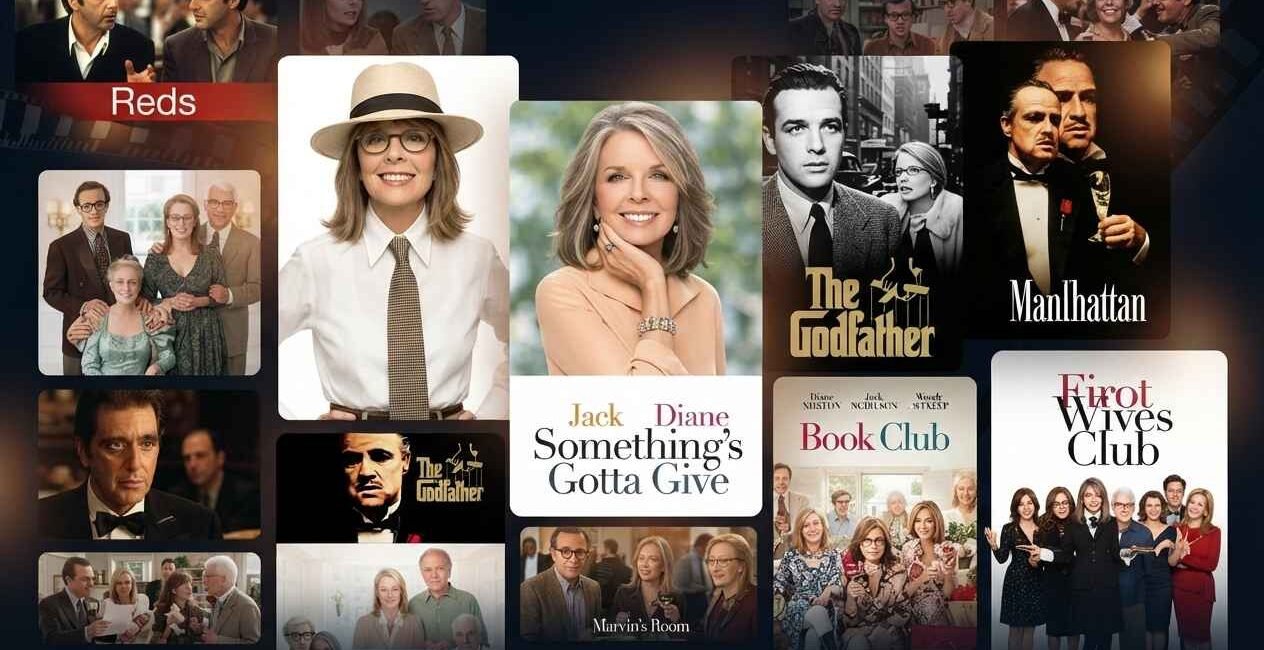
Few actresses have shaped American cinema quite like Diane Keaton. Across more than five decades on screen, she moved effortlessly between comedy and drama, becoming one of Hollywood’s most instantly recognizable and beloved performers. Following her passing in October 2025 at age 79, interest in Diane Keaton movies has surged as longtime fans revisit her filmography and new audiences discover her work for the first time.
This guide walks through her most essential films, the themes that defined her characters, the awards that recognized her talent, where you can watch her work today, and why her performances continue to resonate with audiences decades after they were first released. Whether you’re a lifelong fan looking to revisit her catalog or someone discovering her for the first time, this is meant to be the most complete single resource on Diane Keaton’s film career available online.
Who Was Diane Keaton?
Born Diane Hall on January 5, 1946, in Los Angeles, Diane Keaton began her career on Broadway in the original 1968 production of Hair before transitioning to film the following decade. According to her IMDb profile, she went on to appear in more than 60 films across a career spanning over five decades, becoming one of the defining actresses of American cinema.
Keaton’s Rotten Tomatoes profile notes that she first rose to fame as a favorite collaborator of filmmaker Woody Allen before proving her dramatic range in roles that earned her an Academy Award, a BAFTA, and multiple Golden Globe nominations. Her Britannica biography describes her as an actress who achieved fame in quirky comic roles before gaining serious respect as a dramatic performer — a rare career arc that few of her peers ever managed as successfully.
What made Keaton stand out wasn’t just range, but consistency. From her first credited film role in 1970 to her final on-screen appearance in 2024, she rarely went more than a year or two without a notable project, a longevity documented in detail on her TMDB profile.
Diane Keaton’s Breakout Era: The Godfather & Woody Allen Years
Keaton’s first major film role came as Kay Adams-Corleone in Francis Ford Coppola’s The Godfather (1972), produced by Paramount Pictures. The film, and its 1974 sequel The Godfather Part II, are widely regarded as among the greatest movies ever made, and Kay’s arc — an outsider slowly consumed by the world she married into — gave Keaton a foundation in serious dramatic work early in her career.
At the same time, Keaton began a defining creative and personal partnership with director Woody Allen, starring in Play It Again, Sam (1972), Sleeper (1973), and Love and Death (1975). That collaboration reached its peak with Annie Hall (1977), which won her the Academy Award for Best Actress and became one of the most influential romantic comedies ever made. Coverage from Variety and The Hollywood Reporter has repeatedly cited Annie Hall as a turning point not just for Keaton’s career, but for American comedy filmmaking as a whole, with her wardrobe and delivery becoming a template that influenced a generation of romantic comedies that followed.
That same year, she also delivered a dramatic departure in Looking for Mr. Goodbar (1977), playing a schoolteacher who leads a double life — proving, as Empire and IndieWire have both noted in retrospectives, that she was far more than a comic muse. She followed it with Woody Allen’s Interiors (1978) and Manhattan (1979), further cementing her as one of the most versatile performers of the decade.
Diane Keaton’s Best Movies, Ranked
Based on critical reception, box office performance, awards recognition, and lasting cultural impact, here are Diane Keaton’s most essential films:
- Annie Hall (1977) – Her Oscar-winning, career-defining performance as the title character opposite Woody Allen; widely considered one of the greatest romantic comedies ever made and a landmark in American filmmaking.
- The Godfather (1972) / The Godfather Part II (1974) – Her portrayal of Kay Corleone remains one of cinema’s most memorable supporting roles, anchoring the emotional throughline of Coppola’s crime saga.
- Reds (1981) – Opposite Warren Beatty, this historical epic earned Keaton an Academy Award nomination for Best Actress and is often cited as one of her most underrated dramatic performances.
- Manhattan (1979) – A defining Woody Allen collaboration shot in striking black-and-white, showcasing Keaton’s chemistry with Allen at its peak.
- Something’s Gotta Give (2003) – A late-career triumph opposite Jack Nicholson that reintroduced Keaton to a new generation and earned her a Golden Globe for Best Actress.
- The First Wives Club (1996) – A box-office smash and feminist comedy classic co-starring Bette Midler and Goldie Hawn, still referenced today as a defining ensemble comedy of the 1990s.
- Baby Boom (1987) – A beloved career-woman comedy that helped define the “working mother” genre of late-1980s Hollywood.
- Father of the Bride (1991) / Father of the Bride Part II (1995) – Opposite Steve Martin, these hugely popular family comedies remain holiday-season staples decades later.
- Marvin’s Room (1996) – A quietly powerful drama opposite Meryl Streep and a young Leonardo DiCaprio that earned Keaton an Academy Award nomination for Best Actress.
- Book Club (2018) – A late-career hit alongside Jane Fonda, Candice Bergen, and Mary Steenburgen that introduced Keaton’s work to an entirely new generation of viewers.
Rolling Stone and Vulture both featured Keaton prominently in their In Memoriam retrospectives following her death, highlighting how consistently her performances resonated across genres, decades, and audiences of every age.
Diane Keaton’s Complete Filmography by Decade
1970s: The Breakthrough Decade
Keaton made her screen debut in Lovers and Other Strangers (1970) before landing her career-making role in The Godfather (1972). The decade also included Play It Again, Sam (1972), Sleeper (1973), The Godfather Part II (1974), Love and Death (1975), I Will, I Will… for Now (1976), Annie Hall (1977), Looking for Mr. Goodbar (1977), Interiors (1978), and Manhattan (1979) — arguably the strongest single decade of any actress working at the time.
1980s: Dramatic Range
Following her Oscar win, Keaton spent the 1980s proving her range across genres: Reds (1981), Shoot the Moon (1982), The Little Drummer Girl (1984), Crimes of the Heart (1986), her directorial debut with the documentary Heaven (1987), the comedy hit Baby Boom (1987), and The Good Mother (1988).
1990s: Comedy Comeback
The 1990s saw Keaton return to comedy while continuing to earn dramatic acclaim: The Godfather Part III (1990), Father of the Bride (1991), Manhattan Murder Mystery (1993), Father of the Bride Part II (1995), the Oscar-nominated Marvin’s Room (1996), the box-office hit The First Wives Club (1996), and her directorial effort Hanging Up (2000).
2000s: A Late-Career Resurgence
Something’s Gotta Give (2003) marked one of the most celebrated performances of Keaton’s later career, followed by The Family Stone (2005), Because I Said So (2007), and Mad Money (2008).
2010s and Beyond: A Beloved Elder Stateswoman of Film
Keaton continued working steadily into her seventies, appearing in Morning Glory (2010), The Big Wedding (2013), voicing a supporting role in Pixar’s Finding Dory (2016), starring in the hit ensemble comedy Book Club (2018), Poms (2019), and finally Summer Camp (2024) alongside Kathy Bates and Eugene Levy — her last film role.
For a full, continuously updated film-by-film breakdown with cast and crew details, IMDb’s complete filmography page remains the most comprehensive reference source available.
Which Diane Keaton Movie Should You Watch First?
For newcomers unsure where to start, here’s a simple guide based on what you’re in the mood for:
- Want a classic romantic comedy? Start with Annie Hall (1977) — it’s the film that defines her career and remains as sharp and funny today as it was in 1977.
- Want prestige drama? Watch The Godfather (1972) and The Godfather Part II (1974) for her most iconic dramatic work.
- Want a feel-good comfort watch? Something’s Gotta Give (2003) or Book Club (2018) are both warm, accessible entry points.
- Want an underrated hidden gem? Baby Boom (1987) and Marvin’s Room (1996) are frequently cited by critics at outlets like Collider and Slashfilm as deserving far more attention than they get.
- Want a girls’-night comedy? The First Wives Club (1996) remains one of the most quoted ensemble comedies of the 1990s.
Recurring Themes & Character Types in Her Films
Across decades, Diane Keaton gravitated toward — and helped define — a particular type of character: intelligent, independent-minded women navigating love, family, and self-discovery, often with a distinctive blend of humor and vulnerability. Film historians writing for outlets like BFI and Sight & Sound have noted that her characters rarely fit neatly into traditional “leading lady” boxes; instead, they were frequently eccentric, non-conformist, and refreshingly unpolished.
This throughline connects seemingly unrelated films: Annie Hall’s neurotic charm, Kay Corleone’s quiet moral reckoning, Erica Barry’s late-life reawakening in Something’s Gotta Give, and Diane’s book-club rediscovery of passion in Book Club all share a common DNA — women finding their voice on their own terms, often later than convention would suggest is possible. It’s a thread that made her work feel relevant across five different decades of changing audience expectations.
Awards & Recognition
Diane Keaton’s accolades, as documented by the Academy of Motion Picture Arts and Sciences, the British Academy Film Awards, and the Golden Globes, include:
- Academy Award for Best Actress – Annie Hall (1978)
- Academy Award nominations – Reds (1981), Marvin’s Room (1996)
- BAFTA Award for Best Actress – Annie Hall
- BAFTA nominations – Reds, Manhattan
- Golden Globe Award – Best Actress in a Comedy or Musical, Annie Hall; also won for Something’s Gotta Give
- AFI Life Achievement Award (2017), presented by the American Film Institute
- Screen Actors Guild recognition, documented through the SAG Awards archive
These honors, spanning nearly the entirety of her career, cement her status as one of the most consistently decorated actresses of her generation.
Where to Watch Diane Keaton Movies Today
Many of Keaton’s films are widely available across major streaming platforms, including Netflix, Amazon Prime Video, Disney+ (home to Finding Dory), and Paramount+ (home to The Godfather trilogy). Something’s Gotta Give and several of her 2000s titles frequently rotate through Hulu and Max as well.
Classic film enthusiasts can also find restored prints and retrospectives through The Criterion Collection and Turner Classic Movies (TCM), both of which have spotlighted her 1970s work in recent programming.
For film cataloging and personal watchlists, sites like Letterboxd and The Movie Database (TMDB) offer community reviews, ratings, and detailed credits for nearly every title in her filmography — useful if you want to track your way through her catalog systematically.
Diane Keaton as Director
Beyond acting, Keaton built a respected career behind the camera. Her directorial debut, the 1987 documentary Heaven, explored people’s beliefs about the afterlife through a mix of interviews and archival footage. She went on to direct Unstrung Heroes (1995), a comedy-drama starring Andie MacDowell and John Turturro that was selected for the Un Certain Regard section at the Cannes Film Festival, and Hanging Up (2000), a comedy-drama starring herself alongside Meg Ryan and Lisa Kudrow.
Trade coverage from Deadline and Collider has long noted that Keaton’s work as a director, while less prolific than her acting career, showed the same distinctive creative voice — wry, emotionally honest, and unafraid of imperfection — that defined her on-screen performances.
Her Lasting Style & Cultural Influence
Off-screen, Keaton was just as influential as she was in front of the camera. Her androgynous, menswear-inspired style — popularized after Annie Hall — remains referenced in fashion coverage from outlets like Vogue, Harper’s Bazaar, and Elle decades later, and is widely credited with helping normalize women wearing suits, ties, and wide-brimmed hats as everyday fashion statements.
Beyond acting, she was an accomplished photographer, published author, and a passionate architectural preservationist — restoring and renovating historic homes across Los Angeles, an interest she frequently discussed in interviews. She shared glimpses of this broader creative life with fans on her Instagram account, which remained active until her passing.
Her death prompted tributes across the industry, including from People, Entertainment Weekly, and the 2026 Academy Awards In Memoriam segment, all of which described her as one of the most singular and beloved talents in Hollywood history.
Box Office Legacy & Impact on Hollywood Comedy
Beyond critical acclaim, Diane Keaton’s films were also commercially significant. According to data compiled by Box Office Mojo, her films collectively grossed well over a billion dollars in North America alone, a figure driven largely by her run of hit comedies in the 1990s and 2000s — The First Wives Club, Father of the Bride, and Something’s Gotta Give among them.
What made that commercial success notable, as outlets like The Hollywood Reporter and Vanity Fair have pointed out in career retrospectives, is that Keaton achieved much of it in roles built around women in their 40s, 50s, and 60s — a demographic Hollywood has historically underserved at the box office. Something’s Gotta Give, released when Keaton was in her late fifties, became one of the highest-grossing romantic comedies of its year, proving there was substantial commercial demand for stories centered on older women falling in love, reinventing their careers, or simply being unapologetically themselves.
This commercial track record helped pave the way for later ensemble hits like Book Club, which similarly proved — as noted by Deadline in its box office coverage — that audiences would show up in large numbers for stories about women well past the age Hollywood traditionally considered “leading lady” territory. In that sense, Keaton’s career didn’t just produce great films; it helped reshape what the industry believed audiences wanted to watch.
Quick Answers (AEO Snapshot)
The following section is structured for direct-answer visibility in search engines and AI assistants (Answer Engine Optimization).
What is Diane Keaton’s most famous movie? Annie Hall (1977), for which she won the Academy Award for Best Actress.
How many movies did Diane Keaton make? Over 60 films across a career spanning more than five decades, from 1970 to 2024.
What was Diane Keaton’s last movie? Summer Camp (2024), co-starring Kathy Bates and Eugene Levy.
Did Diane Keaton win an Oscar? Yes — Best Actress for Annie Hall in 1978, with additional nominations for Reds and Marvin’s Room.
What is Diane Keaton’s highest-grossing movie? Finding Dory (2016), in which she voiced a supporting role, is her highest-grossing film by worldwide box office.
Frequently Asked Questions
Q1: What are Diane Keaton’s top 5 movies?
Most critics point to Annie Hall, The Godfather, Reds, Manhattan, and Something’s Gotta Give as her five most essential performances.
Q2: Was Diane Keaton in The Godfather?
Yes, she played Kay Adams-Corleone in all three Godfather films (1972, 1974, and 1990).
Q3: What movie did Diane Keaton win an Oscar for?
She won the Academy Award for Best Actress for her role in Annie Hall (1977).
Q4: Did Diane Keaton direct any movies?
Yes, she directed Heaven (1987), Unstrung Heroes (1995), and Hanging Up (2000).
Q5: What was Diane Keaton’s relationship with Woody Allen?
Keaton and Allen were both romantic partners and frequent collaborators in the 1970s, appearing together in films including Play It Again, Sam, Sleeper, Love and Death, Annie Hall, and Manhattan.
Q6: Is Diane Keaton related to Michael Keaton?
No. Despite sharing a surname, the two actors are not related — Diane Keaton was born Diane Hall and adopted her mother’s maiden name for the actors’ guild.
Q7: What awards was Diane Keaton nominated for but didn’t win?
She received Academy Award nominations for Reds (1981) and Marvin’s Room (1996) without winning, alongside several BAFTA nominations beyond her single win.
Q8: Did Diane Keaton appear in any animated films?
Yes — she voiced Jenny, the mother of the title character, in Pixar’s Finding Dory (2016), which went on to become the highest-grossing film of her career by worldwide box office.
Q9: What was Diane Keaton’s connection to fashion?
Beyond acting, Keaton became a genuine style icon. Her menswear-inspired looks in Annie Hall — oversized blazers, ties, and wide-brimmed hats — are still cited by fashion publications as one of the most influential film wardrobes of the 20th century.
From her breakout role in The Godfather to her Oscar-winning turn in Annie Hall and her later career resurgence in films like Something’s Gotta Give and Book Club, Diane Keaton’s filmography represents one of the most versatile and enduring bodies of work in Hollywood history. Her ability to move between screwball comedy and raw drama — often within the same decade — set a standard few actresses have matched, and her influence extended well beyond the screen into fashion, photography, and architectural preservation.
As new generations discover her films through streaming platforms and retrospectives, Diane Keaton’s legacy as one of American cinema’s most original and enduring voices continues to grow.

The Seecom is your trusted source for unbiased reviews, expert analysis, and comprehensive comparisons to help you choose with confidence.

Other Articles

Tom Hanks Movies: The Complete List & Guide
Tom Cruise Movies: The Complete Ranked Guide (Every Era, 2026 Update)