






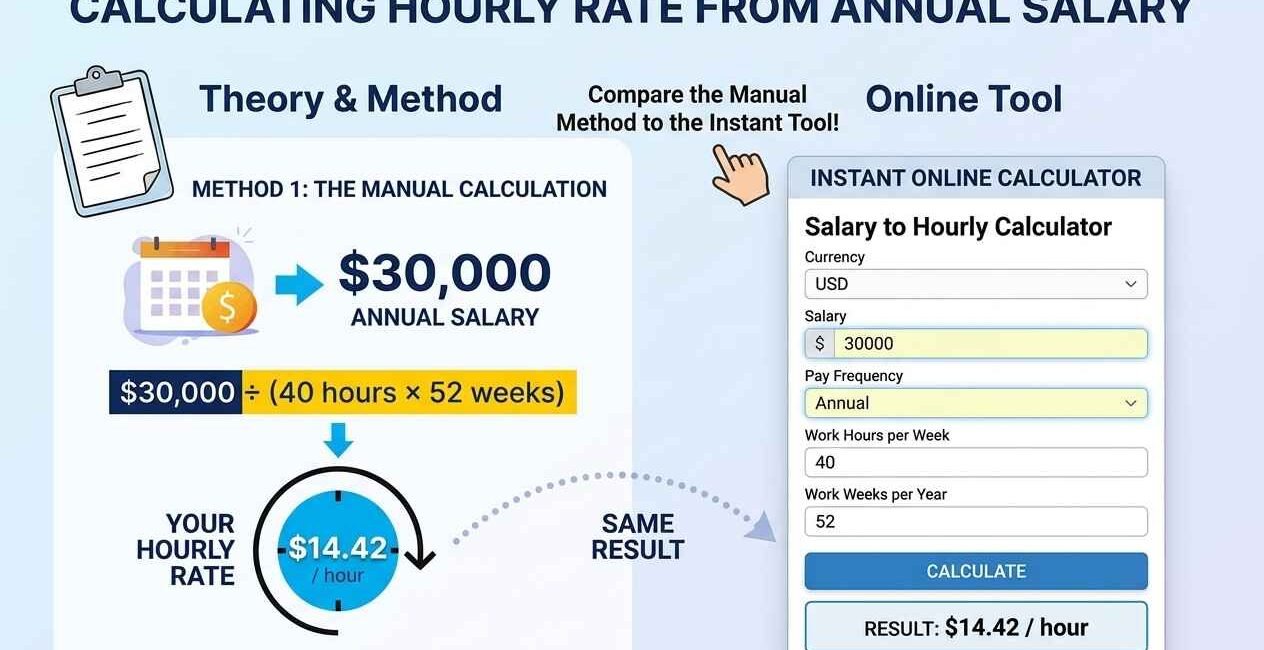
Whether you’re comparing a salaried job offer to an hourly one, negotiating a raise, or just curious what you actually earn per hour, converting an annual salary to an hourly rate is a simple calculation once you know the right number of working hours to divide by. This guide walks through the formula, a worked example, and the details most online calculators skip.
The Basic Formula
The standard formula assumes a typical full-time schedule of 40 hours per week, 52 weeks per year:
Hourly Rate = Annual Salary ÷ 2,080
(2,080 comes from 40 hours × 52 weeks.)
Step-by-Step Calculation
- Take your gross annual salary (before tax)
- Divide it by 2,080 if you work a standard 40-hour week
- If you work a different number of weekly hours, multiply your weekly hours by 52 instead, and divide your salary by that number
Worked Example
If your annual salary is $52,000 and you work a standard 40-hour week:
$52,000 ÷ 2,080 = $25 per hour
If instead you work 37.5 hours a week (common in the UK and in many office jobs):
37.5 × 52 = 1,950 hours per year
$52,000 ÷ 1,950 = $26.67 per hour
Notice how working fewer hours per week for the same salary results in a higher effective hourly rate — this is a common point of confusion when comparing two job offers with different weekly hours.
Accounting for Paid Time Off
The 2,080-hour figure assumes you work every single week of the year, which isn’t realistic once you factor in holidays and paid vacation. For a more accurate “hours actually worked” rate:
- Subtract your paid vacation and holiday days from 52 weeks (e.g., 4 weeks off = 48 working weeks)
- Multiply working weeks by your weekly hours (48 × 40 = 1,920 hours)
- Divide your salary by this adjusted figure instead of 2,080
This gives a slightly higher hourly figure, since you’re still paid your full salary despite working fewer actual hours across the year.
Monthly or Weekly Salary to Hourly
- Monthly salary → hourly: Monthly salary × 12 ÷ 2,080
- Weekly salary → hourly: Weekly salary ÷ your weekly hours
- Bi-weekly salary → hourly: Bi-weekly salary × 26 ÷ 2,080
Common Mistakes
- Using net (take-home) salary instead of gross — hourly rate comparisons should always use pre-tax figures
- Assuming everyone uses 2,080 hours — part-time roles, compressed workweeks, and international standard hours (37.5 in the UK, for example) all change the divisor
- Forgetting unpaid overtime — if you regularly work extra unpaid hours, your real effective hourly rate is lower than the formula suggests
Related Tools
Once you know your hourly rate, you can work out your overtime pay using our Overtime Pay Calculation Guide, or see what actually lands in your bank account after tax and deductions with our Take-Home Pay Calculator.
For official wage and hour standards, the U.S. Department of Labor’s FLSA overview and the UK’s National Minimum Wage guidance are both useful references for confirming what counts as a standard working week where you live.

The Seecom is your trusted source for unbiased reviews, expert analysis, and comprehensive comparisons to help you choose with confidence.

Other Articles