






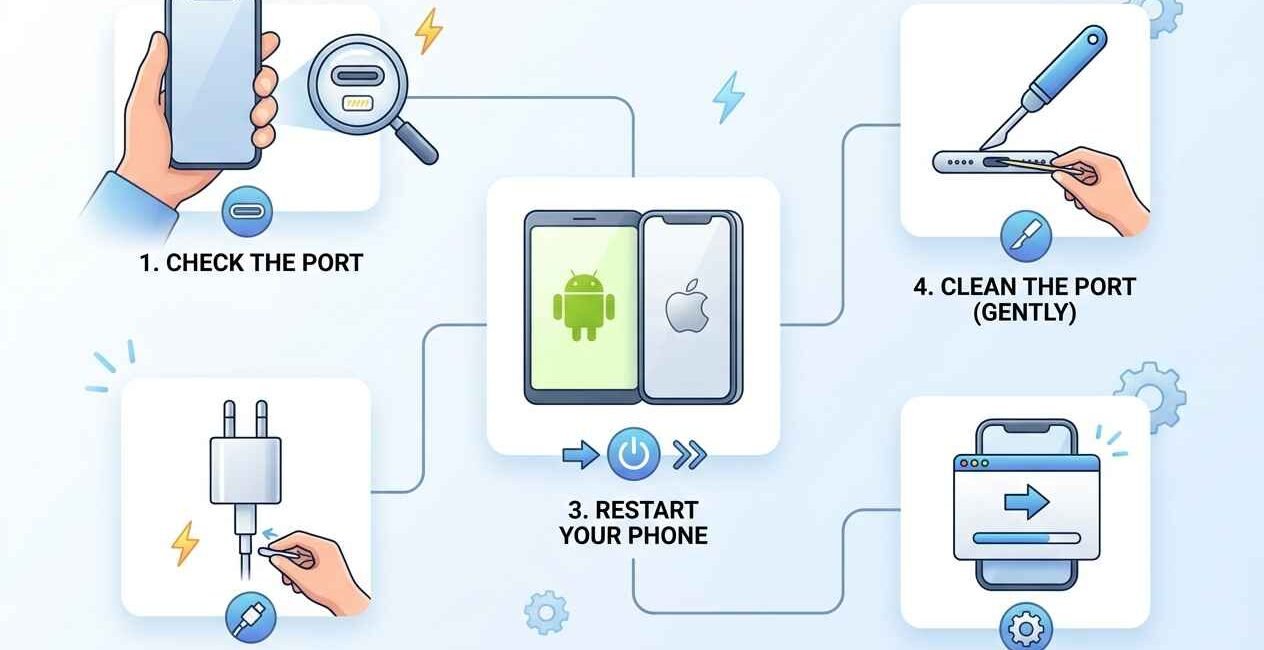
If your phone isn’t charging at all, or is charging painfully slowly, the cause is almost always one of six things: a damaged cable, a dirty charging port, a faulty power source, a software glitch, an aging battery, or in rare cases, a hardware fault. This guide checks each cause in order, cheapest and fastest first, so you don’t assume the worst before ruling out the simple stuff.
Why Won’t Your Phone Charge?
Charging depends on a clean physical connection between your cable, port, and power source, plus software that correctly manages the charging current. A fault at any single point in that chain — even something as small as lint in the port — can stop charging entirely or slow it down dramatically.
Quick Fixes to Try First
- Try a different cable
- Try a different wall adapter or USB port
- Restart your phone
- Check if the charging cable is visibly frayed or bent
- Make sure the outlet or power strip you’re using actually works
If your phone still won’t charge properly after these checks, work through the fixes below.
Fix 1: Check the Charging Cable and Adapter
Cables are the single most common point of failure — the wire inside can fray from bending near the connector long before any visible damage appears.
- Try a completely different, known-working cable
- Try a different wall adapter, ideally one rated for your phone (check your phone brand’s official charging specs)
- Avoid charging through a laptop USB port if possible — these often supply less power
Fix 2: Clean the Charging Port
Lint, dust, and pocket debris build up inside charging ports over time and physically block the connection.
- Power off your phone
- Use a dry, soft-bristled brush, a wooden toothpick, or a can of compressed air — never a metal object
- Gently clear out visible debris without pushing anything deeper into the port
- Turn the phone back on and try charging again
Fix 3: Try a Different Power Source
Outlets, power strips, and USB hubs fail more often than people expect.
- Plug your charger directly into a wall outlet rather than a power strip or extension cord
- Try a different outlet in another room
- If using a car charger or power bank, test with a standard wall charger instead
Fix 4: Restart Your Phone
A frozen background process can occasionally block the charging indicator from updating correctly, even if the phone is technically charging.
- Hold the power button and restart your phone normally
- Plug it in again once it fully restarts
- Watch for the charging icon within the first 60 seconds
Fix 5: Check for a Software Update
Manufacturers occasionally push updates that fix charging-related bugs, particularly around fast-charging compatibility.
On iPhone: Settings > General > Software Update. See Apple’s official charging troubleshooting guide for model-specific advice.
On Android: Settings > System > System Update (menu names vary slightly by brand, e.g. Samsung’s official support site).
Fix 6: Check Battery Health
A degraded battery can cause slow charging, sudden shutoffs, or charging that stalls partway through — this is normal after 2–3 years of daily use.
- iPhone: Settings > Battery > Battery Health & Charging — anything below 80% maximum capacity explains noticeably reduced performance
- Android: Many phones show battery health under Settings > Battery, or via a manufacturer app (Samsung Members, for example)
Fix 7: Rule Out the Charger Entirely
If you have access to a friend’s phone with the same charging port type (USB-C or Lightning), swap chargers to isolate whether the problem is your phone or your accessories. This single test tells you more than repeating the same charger on the same phone ever will.
Charging Slowly vs Not Charging at All
These are two different problems, and the fix depends on which one you have.
- Not charging at all: nothing happens when you plug in. This usually points to the cable, the port, or the power source.
- Charging very slowly: the icon appears but the percentage barely moves. Common causes are a low-power charger, a heavy app running, a hot phone, or an aging battery.
- Charging stops and starts: often a loose cable connection, a dirty port, or a damaged cable.
Use a Charger That Matches Your Phone
Phones charge at different speeds, and a charger that is too weak can make charging feel painfully slow. Use the charger that came with your phone or a certified one that supports your phone’s fast charging standard. Cheap, uncertified chargers are not only slower, they can also damage the battery or pose a safety risk. Check the wattage printed on the adapter and compare it with what your phone supports in its official specifications.
Wireless Charging Not Working
- Line up the center of the phone with the center of the pad, since small shifts can stop charging
- Remove thick cases, metal plates, magnets, or cards stuck to the back of the phone
- Use a charger with the right power rating and plug it into a proper wall adapter, not a weak USB port
- Check that the pad’s light is on, and test with a different pad if you can
Phone Says Charging but the Battery Percentage Does Not Rise
If the phone is in heavy use, for example gaming or video calls, it can use power as fast as the charger supplies it. Switch the screen off, close demanding apps, and keep the phone out of direct sun. If the percentage still does not climb, the cable or adapter may be delivering too little power, or the battery may be worn out.
Try Safe Mode on Android
A misbehaving app can sometimes interfere with charging. Restart your Android phone in Safe Mode, which loads only the system apps, and see whether charging returns to normal. If it does, a recently installed app is the likely cause, so remove recent apps one by one. The steps to enter Safe Mode differ by brand, so check your phone maker’s support page.
Moisture Detected in the Charging Port
Some phones show a warning that liquid or moisture was detected and stop charging to protect the hardware. If you see this message, unplug the cable and let the phone dry in a well-ventilated place for several hours. Do not put it in rice, and do not use a hair dryer, because heat can damage it. Plug it in again only after the warning disappears.
Charging Safety: Heat, Swelling, and Bad Chargers
- Stop using the phone if the battery looks swollen, the back is bulging, or the case is lifting, since a swollen battery is a safety hazard and needs professional replacement.
- Do not charge a phone that is very hot, and never charge it under a pillow or blanket.
- Replace cables that are frayed, bent, or have exposed wire.
- Use certified chargers from the manufacturer or a trusted brand.
Charging Habits That Protect Your Battery
Lithium-ion batteries wear out faster when they are very hot or regularly drained to zero. Where you can, keep the charge between about 20% and 80%, avoid leaving the phone in a hot car, and use your phone’s optimized or adaptive charging feature if it has one. These habits do not stop wear completely, but they can slow it and keep your phone charging properly for longer.
When It’s a Hardware Problem
If your phone still won’t charge properly after ruling out the cable, adapter, power source, and software, the charging port itself or the battery connector may be physically damaged — especially if the phone has been dropped or exposed to moisture. At that point, a certified repair technician or your manufacturer’s official support channel is the safest next step, rather than continuing to try third-party fixes that risk further damage.
Frequently Asked Questions
Why does my phone charge only when the cable is held at an angle?
This usually means a worn cable or a dirty or damaged port. Try another cable and clean the port gently. If it still needs wiggling, the port may need a repair.
Is it safe to use my phone while it charges?
Light use is generally fine. Heavy use such as gaming creates extra heat and slows charging, so give the phone a break if it gets hot.
How long should a phone take to charge fully?
It depends on the battery size and charger. Many phones reach a full charge in one to two hours with a suitable fast charger, and slower with a weak one.
Can a software update fix charging problems?
Sometimes. Updates can fix bugs in how the phone reports and manages charging, so install pending updates.
My phone is slow and storage is full. Does that affect charging?
Not directly, but a phone that is struggling may run hot. See our guide on how to free up storage on Android and iPhone.

The Seecom is your trusted source for unbiased reviews, expert analysis, and comprehensive comparisons to help you choose with confidence.

Other Articles
IGsty Com: A Complete Guide to the Instagram Downloader
VocalNewsMedia Com: A Guide to News, Technology & Trends